
The FCA has published its latest proposals to simplify the Senior Managers & Certification Regime (SM&CR) including removing the Certification Regime and Directory, reducing approval requirements and easing reporting duties. But senior manager accountability and the Conduct Rules would remain. We examine the proposed changes, what they could mean for consumer credit firms and the obligations that would continue. With the consultation closing on 22 January 2027, firms have an opportunity to consider the proposals, but must continue to meet existing requirements until any new rules take effect.
Introduction
On 22 October 2026 the FCA published CP26/37, the second phase of its review of the Senior Managers & Certification Regime (SM&CR). It proposes removing the Certification Regime and the Directory, moving some senior management roles from regulatory approval to notification, and simplifying responsibility records, Conduct Rules training and breach reporting. The core of the regime, senior manager accountability and the Conduct Rules, would remain. (CP26/37, Chapters 1 and 2.)
These are proposals only. Responses close on 22 January 2027. The FCA expects to publish final rules in the first half of 2027 and proposes implementation around six months later, in the second half of 2027. The reforms depend on the outcome of the parliamentary process for the Financial Services and Markets Bill, and the FCA has said it will not take steps to repeal the Certification Regime before reaching a final policy position. (CP26/37, Chapters 1 and 6.)
Background
The SM&CR is an individual accountability regime. The Financial Services and Markets Act 2000 sets its framework, and the FCA and PRA make rules to implement it. Its main elements are the Senior Managers Regime, the Certification Regime for staff below senior manager level, and the Conduct Rules. Requirements apply proportionately, with dual-regulated and Enhanced firms subject to more than Core and Limited Scope firms. (CP26/37, Chapters 2 and 4.)
The review began in December 2022. Phase 1, finalised in PS26/6 in April 2026, made changes possible within the existing legislation. Phase 2 relies on the Financial Services and Markets Bill, which would remove many prescriptive SM&CR requirements from legislation and leave the regulators to decide how they should apply. (CP26/37, Chapters 1 and 2.)
The Government, FCA and PRA share an ambition to reduce the regulatory burden of the SM&CR by 50% and the number of roles at banks and insurers requiring approval by 40%, while maintaining robust individual accountability. The FCA says its proposals, combined with the PRA’s, will meet that ambition. It accepts that some risks may increase but considers that important safeguards remain. (CP26/37, Chapters 1 and 2.)
Key Regulatory Developments
Certification, regulatory references and the Directory
The FCA proposes removing the Certification Regime entirely, including annual certification. It would instead rely on existing requirements for firms to employ competent and suitable staff, together with Training and Competence requirements, Statements of Professional Standing where relevant, the Consumer Duty and the Conduct Rules. Firms would remain responsible for assessing competence and suitability through their own processes. (CP26/37, Chapter 4.)
Regulatory references would no longer be required for previously certified staff. They would remain required for senior manager appointments, whether approved or notified, and for some other roles, such as certain board director appointments that are not senior manager roles. The Directory, with its associated reporting and attestation, would be retired. (CP26/37, Chapter 4 and Appendix 1.)
The FCA invites views on whether any features of certification, regulatory references or the Directory should be kept. It has said that if it decides to keep or amend any part of the Certification Regime or the Directory, it does not intend to consult again. (CP26/37, Chapter 4.)
Senior Managers Regime
At Enhanced and dual-regulated firms, several oversight and non-executive roles would move from regulatory approval to notification, including the Head of Internal Audit, specified committee chairs and the Senior Independent Director. Firms would still need to vet these individuals and assess their fitness and propriety before appointment, and the Duty of Responsibility and Senior Manager Conduct Rules would continue to apply. The FCA could require pre-approval at a particular firm in exceptional cases. No changes to senior manager roles are proposed for Core and Limited Scope firms. (CP26/37, Chapter 3.)
The FCA also proposes removing two FCA-only functions, Other Overall Responsibility (SMF18) and Local Responsibility (SMF22), with their responsibilities reallocated to remaining senior managers. It asks whether they should instead become notified roles. For solo-regulated firms, the Group Entity Senior Manager function (SMF7) would be narrowed to individuals who both exercise significant influence over the firm and perform one of a specified list of group functions. (CP26/37, Chapter 3.)
Enhanced thresholds and temporary cover
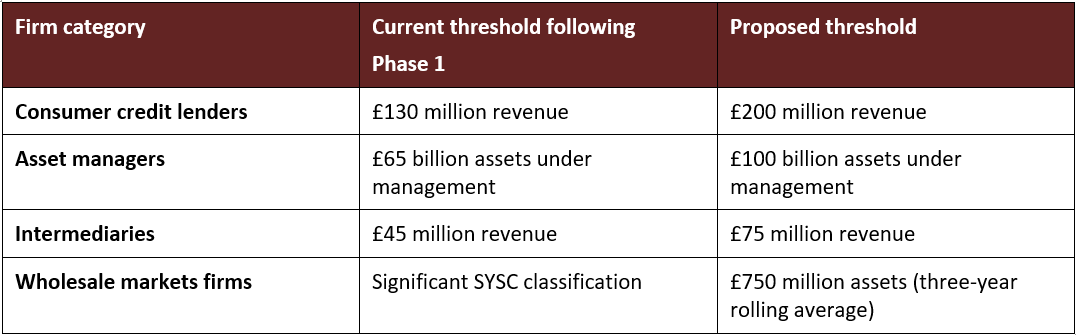
The FCA proposes raising several Enhanced thresholds, so fewer firms would be classified as Enhanced. Firms that cease to be Enhanced would remain subject to the Core requirements. The mortgage and client asset thresholds would not change. The proposed thresholds are set out below. (CP26/37, Chapter 3.)
The temporary cover arrangements known as the “12-week rule” would be extended, giving firms 18 weeks to submit an application or notification. The FCA also proposes replacing the requirement that an absence be “reasonably unforeseen” with a test of “reasonable use”. The PRA proposes to keep its existing test, and the FCA asks whether its change should apply only to solo-regulated firms. (CP26/37, Chapter 3.)
Responsibility records
Firms would no longer need to submit updated Statements of Responsibilities or Management Responsibilities Maps each time responsibilities change. They would still need to keep them up to date internally, retain past versions and provide them to the regulators when required. Neither would be needed where a single individual performs all senior manager roles at a firm. (CP26/37, Chapter 3.)
Nine Prescribed Responsibilities would be removed, leaving a small core set covering the Senior Managers Regime, financial crime, client assets and, for Enhanced firms, oversight of outsourced internal audit. The underlying requirements would remain. (CP26/37, Chapter 3.)
Conduct Rules
The Conduct Rules themselves would not change. The specific requirement to train staff on them would be replaced by a requirement to notify staff of the rules that apply to them and the consequences of breach. Other training obligations, for example under Training and Competence rules or the Consumer Duty, would continue to apply where relevant. Sole traders would be brought within the Conduct Rules. (CP26/37, Chapters 4 and 5.)
For most staff below senior manager level, breach reporting would be limited to disciplinary action resulting in a final written warning or dismissal, reported within 14 months and reflecting the outcome of any internal appeal. Faster reporting would apply to non-executive directors and others subject to the Senior Manager Conduct Rules, and reporting for senior managers themselves would not change. Firms would still need to notify the FCA promptly of significant matters, including significant Conduct Rule breaches. (CP26/37, Chapter 5.)
Proposed guidance would confirm that, for breach reporting purposes, firms need not determine whether misconduct breaches the Conduct Rules where the resulting disciplinary action would not be reportable. The regulatory reference template would be updated to reflect the new reporting thresholds, although firms would still need to disclose other information relevant to fitness and propriety. (CP26/37, Chapter 5.)
Implications for Firms
For now, firms should continue to comply with the current regime. Certification, Directory reporting, Conduct Rules training and existing breach reporting continue to apply until new rules take effect, and the final package may differ from these proposals. Process changes should be planned around the final rules and their commencement, not the consultation.
Preparatory work should separate what is required solely by the SM&CR from obligations that would continue, such as competence and suitability assessments, regulatory references for senior and certain board appointments, training required by other rules and wider notification duties. Removing certification need not mean recreating it under another name, but firms should be able to show how continuing obligations are met.
Enhanced and dual-regulated firms are most affected by the senior manager proposals, including the reallocation of responsibilities held by SMF18, SMF22 and SMF7 holders. Consumer credit lenders and intermediaries near the current thresholds should check their classification against all the Enhanced criteria. Smaller firms should consider the simplified responsibility records. HR, compliance and legal teams should review disciplinary processes and breach reporting together.
Wider Context
Dual-regulated firms should read the PRA’s parallel consultation, CP14/26, alongside the FCA’s. The proposals are coordinated but differ in several areas, including group-level senior managers, notified roles, temporary cover, Prescribed Responsibilities and breach reporting. (CP26/37, Chapters 1, 3 and 5.)
The FCA estimates that its proposals would reduce annual SM&CR compliance costs by around £229 million, about 53%, with one-off transition costs of £61.7 million. The largest saving comes from removing the Certification Regime, part of which the FCA attributes to changes already made in Phase 1. These are estimates of compliance costs avoided, not guaranteed savings for any individual firm. (CP26/37, Annex 2.)
Key Takeaways
1. Maintain current compliance. Existing requirements continue until the final rules take effect. Plan changes around the final rules and commencement, not the consultation.
2. Respond where it matters. Responses close on 22 January 2027. The FCA does not intend to consult again if it decides to keep or amend parts of certification or the Directory.
3. Map who is affected. Identify roles that would become notified, be removed or change scope, and the responsibilities that would need reallocating.
4. Keep what continues. Competence and suitability assessments, regulatory references for senior and certain board appointments, other training obligations and wider notification duties would remain.
5. Check classification and records. Consider all applicable Enhanced criteria and what simplified responsibility records and Prescribed Responsibilities would mean for your firm.
6. Align HR and compliance. Reporting thresholds and timing would differ by staff category, so disciplinary processes and breach reporting should be reviewed together.
To book an initial chat to discuss this topic please get in touch with the Auxillias team via the details here.